
Vietnam has become the world’s leading supplier of frozen pangasius thanks to its integrated farming system, modern seafood factories, experienced workforce, and internationally recognized food safety standards. Every year, millions of tons of pangasius are harvested from the Mekong Delta and exported to more than 140 countries.
Unlike many seafood species that rely heavily on seasonal catches, pangasius is produced through a fully controlled aquaculture system. This allows Vietnamese exporters to provide a stable year-round supply with consistent quality, competitive pricing, and reliable delivery schedules.
This article follows the same production journey shown in our YouTube video, providing buyers with a detailed understanding of how frozen pangasius moves from breeding farms to export containers.
Modern Pangasius Farming Begins Long Before Processing
Many seafood buyers focus only on the finished fillet. However, product quality is determined months before fish ever arrive at the processing factory.
Vietnam’s pangasius industry operates through an integrated production chain where hatcheries, grow-out farms, feed manufacturers, processing plants, laboratories, and exporters work together under strict management systems.
Selected broodstock produce healthy fry with stable genetics. Fingerlings are transferred into nursery ponds before moving to commercial grow-out farms located mainly along the Mekong River.
This production model offers several important advantages:
- Continuous raw material supply
- Uniform fish size
- Excellent feed conversion ratio
- Stable harvesting schedules
- Complete traceability
For international buyers, these advantages translate into dependable production planning and long-term purchasing opportunities.
Why Vietnam Dominates Global Pangasius Production
Vietnam possesses several unique advantages that few competing countries can match.
Favorable Natural Conditions
The Mekong Delta provides abundant freshwater, warm temperatures throughout the year, and extensive farming areas suitable for intensive aquaculture.
Advanced Aquaculture Technology
Modern farms use automatic feeding systems, water quality monitoring, disease prevention programs, and strict biosecurity measures to optimize fish growth.
Large Processing Capacity
Many export factories process hundreds of tons of pangasius every day using automated production lines combined with experienced manual filleting teams.
Global Export Experience
Vietnamese seafood companies have decades of experience serving retail, wholesale, foodservice, and industrial buyers across Europe, North America, South America, the Middle East, and Asia.
From Farm to Factory: A Carefully Controlled Supply Chain
One of the most impressive aspects of Vietnam’s pangasius industry is the short transportation time between harvest ponds and processing factories.
Fish are harvested according to factory production schedules rather than stored for long periods. Live fish are transported directly by specialized boats equipped with oxygen systems to maintain freshness throughout transportation.
Upon arrival, every batch undergoes quality inspection before entering production.
Maintaining freshness at this stage helps preserve:
- Natural white meat color
- Better texture
- Higher fillet yield
- Lower bacterial load
- Improved shelf life
This efficient logistics system is one of the reasons Vietnamese frozen pangasius maintains consistent export quality throughout the year.
Related Reading: Pangasius Fish Vietnam – Complete Guide to Swai Fish for Importers
Related Products: Pangasius (Swai Fish) Products
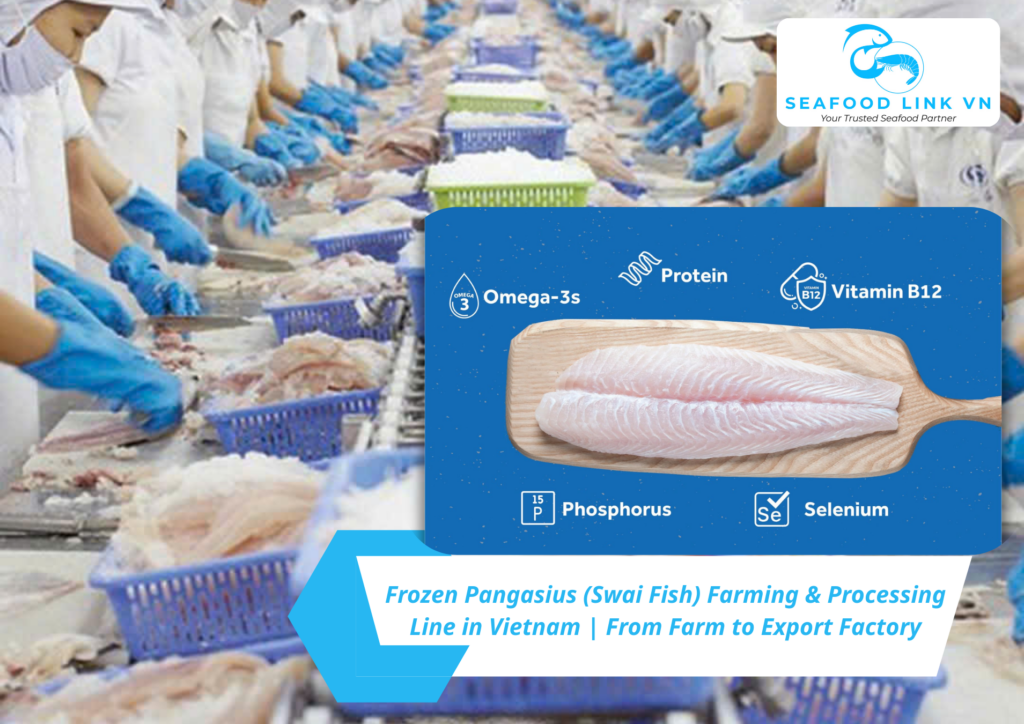
Frozen Pangasius Processing Line from Farm to Export Factory
Inside the Frozen Pangasius Processing Line
After live fish arrive at the factory, production begins immediately. Every processing stage follows HACCP principles and is carefully monitored by production supervisors and quality control personnel.
Rather than relying solely on automation, Vietnamese factories combine advanced machinery with skilled workers to achieve both efficiency and precise product finishing.
Receiving Live Raw Materials
Freshness starts with receiving.
Live pangasius are unloaded directly from transportation boats into factory receiving areas. Each batch is checked for:
- Fish condition
- Average size
- Freshness
- Harvest information
- Farm traceability
Only approved raw materials proceed to production.
Humane Bleeding Before Filleting
Before filleting, workers carefully cut the gills and throat to ensure complete bleeding.
Proper bleeding improves:
- Fillet whiteness
- Product appearance
- Shelf life
- Hygiene
- Final eating quality
This important preparation step is often overlooked but significantly influences export quality.
Skilled Filleting Maximizes Yield
Filleting remains one of the most labor-intensive operations.
Experienced workers remove both fillets while minimizing meat loss and maintaining attractive shape.
Consistent cutting techniques help factories achieve:
- High recovery rates
- Uniform fillet size
- Better appearance
- Lower processing waste
Multiple Washing Stages
Unlike many consumers imagine, pangasius is washed several times during production.
Immediately after filleting, fillets are washed in chilled water between 10–20°C.
After trimming, another washing stage uses aerated water systems to remove remaining blood, loose tissue and impurities.
Before IQF freezing, fillets are washed three additional times to ensure maximum cleanliness.
Each washing stage serves a different purpose, contributing to product safety and appearance.
Skin Removal And Trimming
Automatic skinning machines remove the skin while protecting the meat surface.
Workers then trim away:
- Fat
- Remaining bones
- Red meat
- Belly membrane
- Surface defects
The trimming standard depends on customer specifications.
For premium Well Trimmed products, trimming is much more detailed than for regular export grades.
Quality Inspection On Light Tables
One unique stage inside Vietnamese factories is light table inspection.
Every fillet passes over illuminated inspection tables where trained workers detect:
- Parasites
- Blood spots
- Small bones
- Foreign materials
- Remaining defects
Only fillets meeting customer specifications continue to the next production stage.
This inspection greatly reduces quality claims after shipment.
Moisture Treatment
Depending on customer specifications, fillets may undergo controlled tumbling with approved moisture-retention ingredients.
The tumbling machine distributes moisture evenly throughout the fillet while improving appearance and protecting texture during frozen storage.
Quality Control personnel randomly test moisture content throughout production.
Only batches meeting contractual specifications proceed to freezing.
IQF Freezing
One of the most important stages is Individual Quick Freezing (IQF).
Workers carefully arrange fillets on the conveyor to maximize production capacity while ensuring fillets do not overlap.
Rapid freezing helps preserve:
- Natural texture
- Fillet shape
- Meat structure
- Fresh taste
- Product appearance
Because each fillet freezes individually, customers receive easy-to-handle products without clumping.
Automatic Glazing
After IQF freezing, fillets receive a protective ice coating according to customer specifications.
Glazing percentages vary depending on market requirements.
The glazed fillets pass through IQF once more, securing the protective ice layer before packaging.
This coating protects products from dehydration during long-distance international transportation.
Packing, Cold Storage And Global Export
Following freezing, products move into the final export preparation stages.
Polybag Packing
Workers pack frozen fillets into retail or bulk polybags according to customer requirements.
Each bag passes through a metal detector before carton packing.
This additional inspection helps ensure food safety and compliance with international import standards.
Carton Packing
Products are packed into export cartons displaying:
- Product name
- Size
- Net weight
- Glazing percentage
- Production date
- Lot number
- Country of origin
Customized private labels are also available for supermarket brands and importers.
Cold Storage
Finished products are stored at -18°C or below until shipment.
Modern cold storage facilities maintain stable temperatures to preserve product quality throughout storage and international transportation.
Efficient inventory management allows exporters to prepare shipments quickly while maintaining complete product traceability.
Other Frozen Pangasius Products
Although well-trimmed fillets remain the most popular export item, Vietnamese factories manufacture many additional pangasius products.
These include:
- Well Trimmed Fillet
- Semi Trimmed Fillet
- Untrimmed Fillet
- Pangasius Steak
- Pangasius Butterfly
- Skin-on Fillet
- Fish Portion
- Fish Cube
- Fish Finger
- Breaded Products
- Value-added Products
These products serve supermarkets, wholesalers, foodservice distributors, restaurants, and seafood processors around the world.
Why International Buyers Choose Vietnam
Global seafood buyers continue sourcing frozen pangasius from Vietnam because of several competitive advantages.
✔ Stable year-round production
✔ Competitive pricing
✔ High processing capacity
✔ Experienced export companies
✔ International certifications
✔ Flexible product customization
✔ Reliable container scheduling
✔ Strong quality management systems
For importers seeking dependable long-term seafood partners, Vietnam remains one of the world’s most reliable origins for frozen white fish.
Watch The Complete Frozen Pangasius Processing Line
Our YouTube video provides a complete visual tour of every stage described in this article.
From broodstock selection and fish farming to harvesting, processing, IQF freezing, packaging, and export preparation, buyers can better understand how premium frozen pangasius is produced in Vietnam.
Whether you are sourcing for wholesale distribution, supermarket retail, foodservice, or seafood manufacturing, understanding the production process helps you select the right products and supplier.
Explore More Pangasius Resources
Continue learning through our related articles:
- Seafood Export from Vietnam – Complete Guide for Global Seafood Buyers
- Top 10 Vietnamese Seafood Products Trusted Worldwide in 2026
- Vietnam Pangasius Supplier – Trusted Pangasius Fish Products for Global Buyers
- Pangasius Fillet Products – Sizes, Cuts & Packing Options
- Pangasius Exporter Vietnam – Professional Seafood Export Company
- Top Pangasius Markets – Global Demand for Vietnam Pangasius
- Why Import Pangasius from Vietnam – Benefits for Seafood Buyers
- Vietnam Pangasius Factory – How Pangasius Fish Is Processed for Export
- Pangasius Export from Vietnam – Complete Guide for Global Seafood Buyers
For additional information about Vietnam’s pangasius industry, visit:
https://mekongfishmarket.com/en
Contact Seafood Link VN
Seafood Link VN connects global seafood buyers with trusted Vietnamese seafood manufacturers and exporters.
We support:
- Product sourcing
- Factory matching
- Quality control
- Production monitoring
- Export documentation
- Private label projects
- OEM processing
If you are looking for a reliable Frozen Pangasius Supplier, Swai Fish Exporter, or Vietnam Seafood Export Company, our team is ready to help.
Seafood Link VN
📱 WhatsApp: +84 933 113 379
