
Vietnam has a long coastline, active fishing communities, and an established seafood processing industry supplying frozen octopus to buyers in South Korea, Japan, China, the European Union, the Middle East, and other international markets.
But how does freshly caught octopus become a high-quality frozen export product?
For international seafood buyers, understanding the production process is important because product quality does not start at the processing factory. It starts with the fishing vessel, continues through landing and transportation, and is maintained through receiving, washing, cleaning, grading, freezing, metal detection, packing, storage, and container loading.
At Seafood Link VN, we work with trusted seafood processing factories in Vietnam to support international buyers sourcing frozen octopus, including whole cleaned octopus, baby octopus, cut octopus, boiled octopus, IQF products, and other value-added formats.
This guide explains the typical process of how frozen octopus is processed in Vietnam, including raw material handling, factory processing steps, temperature controls, HACCP principles, representative CCPs, IQF freezing, packing, and export preparation.
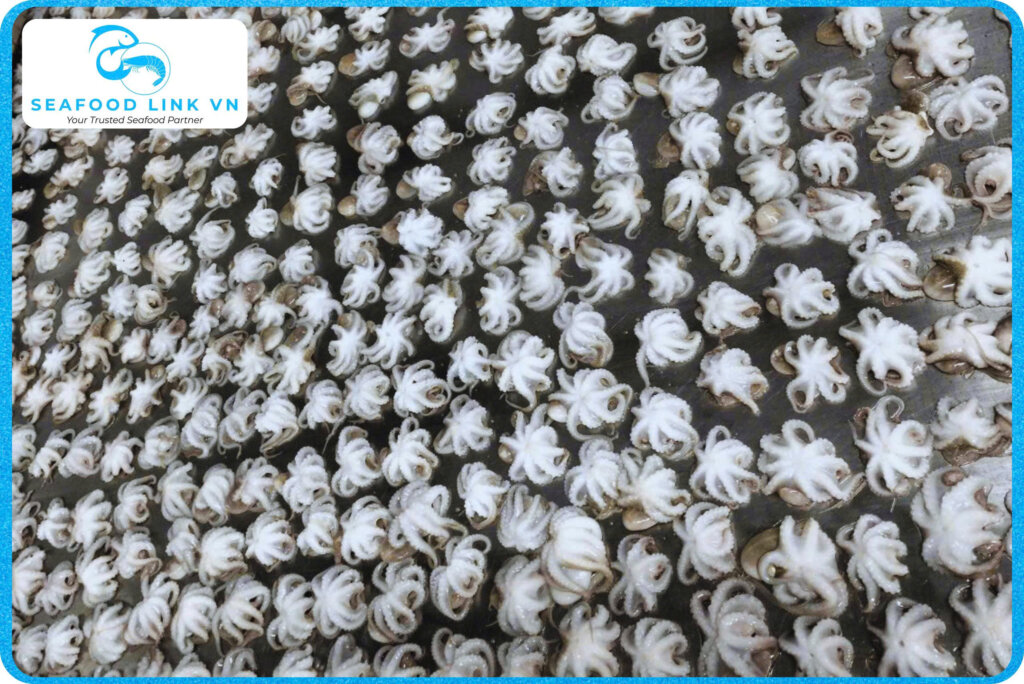
How Frozen Octopus Is Processed in Vietnam from fresh raw material to premium frozen export products.
From Ocean to Frozen Export Product
The production of frozen octopus can be divided into several major stages:
Fishing → Landing → Sorting → Icing/Chilling → Transportation → Factory Receiving → Washing → Cleaning → Grading → Washing → IQF Freezing → Glazing → Packing → Metal Detection → Cold Storage → Container Loading
Maintaining the cold chain throughout these stages is essential.
For wild-caught octopus, quality can deteriorate quickly if the raw material is exposed to excessive temperature or delayed before processing. Therefore, controlling time and temperature from landing to factory receiving is one of the most important aspects of maintaining freshness.
Step 1: Octopus Fishing and Raw Material Sourcing
Vietnamese octopus is mainly sourced from marine fishing activities along the country’s extensive coastline.
Important fishing areas include coastal waters in:
- South Central Vietnam
- Southeast Vietnam
- Southwest Vietnam
- Central coastal provinces
- Northern coastal waters
Different fishing grounds and seasons can provide different sizes and qualities of octopus.
For export production, the objective is not simply to obtain sufficient quantity. Raw material must also meet requirements relating to freshness, size, legality, traceability, and food safety.
Fishing and Handling on Board
After being caught, octopus should be handled carefully to minimize physical damage.
Typical onboard handling includes:
- Catching the octopus
- Removing unwanted foreign materials
- Sorting when appropriate
- Washing or cleaning as required
- Chilling with ice or another approved cooling method
- Storing in clean containers
- Recording relevant catch information
Rapid chilling is important because low temperature slows microbial growth and helps preserve texture.
Step 2: Landing at the Fishing Port
When the fishing vessel returns to port, the catch is unloaded and handled at the landing area.
The raw material is normally inspected for:
- Freshness
- Odor
- Color
- Physical damage
- Size
- Foreign materials
- Temperature
- Traceability information
For export-oriented processing, documentation and traceability are increasingly important.
The legality of wild-caught seafood is also an important part of international market access. Vietnam has strengthened monitoring, control, surveillance, and traceability systems as part of its efforts to combat illegal, unreported and unregulated fishing.
This means seafood exporters increasingly need to connect the factory’s production records with information about the origin of the raw material.
Step 3: Chilled Transportation to the Processing Factory
After landing, octopus should be transported to the processing facility under controlled temperature conditions.
The objective is to prevent temperature abuse between the fishing port and factory.
Depending on the supply chain, raw material may be transported using:
- Insulated containers
- Ice
- Refrigerated vehicles
- Food-grade plastic containers
The transportation process should protect the octopus from:
- Excessive temperature
- Direct sunlight
- Physical contamination
- Cross-contamination
- Excessive handling
The shorter the time between landing and processing, the easier it is to maintain good raw material quality.
Step 4: Receiving Raw Materials at the Factory
When octopus arrives at the processing factory, the receiving department checks the raw material before it enters production.
A representative processing specification for frozen baby octopus uses a raw material temperature of ≤4°C at receiving.
Typical receiving checks include:
Temperature
Raw material temperature is checked and recorded.
Freshness
QC personnel inspect:
- Color
- Odor
- Texture
- Appearance
- Decomposition signs
Size and Quantity
The factory verifies the quantity and preliminary size distribution against the production order.
Traceability
Information relating to the raw material lot is recorded so that the finished product can be traced back through the production system.
Step 5: First Washing
After receiving, the octopus is washed using clean water under controlled sanitary conditions.
A representative factory flow chart specifies:
- Water temperature: ≤4°C
- Approximate basket quantity: 10 kg/basket
- Washing time: approximately 20 seconds/basket
- Washing water replaced after approximately 100 kg
The purpose of washing is to remove:
- Sand
- Mud
- Blood
- Surface contaminants
- Foreign materials
Water quality and water temperature are important control parameters.
Step 6: Temporary Storage of Raw Materials
If the raw material cannot immediately enter the next processing stage, it is kept under controlled chilled conditions.
The representative flow chart specifies:
- Product temperature: ≤4°C
- Salt content: ≤1%
- Storage time: ≤8 hours
The purpose of this stage is to prevent unnecessary temperature increase and minimize the time that raw materials remain in storage before processing.
For seafood, “time-temperature control” is more important than simply having a cold room.
Step 7: Preliminary Processing and Cleaning
The octopus then enters the preliminary processing stage.
Depending on the product specification, operators may remove:
- Eyes
- Beak/teeth
- Internal organs
- Gut
- Unwanted foreign materials
For whole cleaned baby octopus, the objective is to retain an attractive whole shape while removing unwanted internal parts.
For other products, the raw material may be further cut into:
- Whole cleaned octopus
- Tentacles
- Cut octopus
- Small pieces
- Value-added formats
The product temperature should remain controlled during processing.
In the representative flow chart, semi-finished products are maintained at ≤7°C at this stage.
Step 8: Second Washing
After preliminary cleaning, the semi-finished octopus is washed again.
The representative process specifies:
- Water temperature: ≤4°C
- Approximate quantity: 10 kg/basket
- Washing time: approximately 20 seconds/basket
- Water replacement after approximately 100 kg
This second washing step helps remove remaining contaminants from the cleaning operation.
Good hygiene practices are particularly important because the product has now been handled extensively by workers and equipment.
Step 9: Size Classification
After cleaning, octopus is graded according to the customer’s specifications.
Common commercial grading may be based on:
- Pieces per kilogram
- Grams per piece
- Length
- Whole or cut format
For example, whole cleaned octopus may be supplied in different size ranges depending on market demand.
Baby octopus may also be classified into customer-specific M, L, 2L, or other grades.
Why Size Classification Matters
Accurate grading provides:
- Consistent product presentation
- Better portion control
- More predictable cooking performance
- Easier retail packaging
- Better customer satisfaction
For B2B buyers, size consistency is particularly important because it directly affects yield, pricing, and product positioning.
Step 10: Chilled Storage of Semi-Finished Products
After size classification, semi-finished octopus may be temporarily stored before final washing and freezing.
The representative process specifies:
- Product temperature: ≤4°C
- Salt content: ≤1%
- Storage time: ≤4 hours
This short holding period helps minimize the time between cleaning and freezing.
The basic principle is simple:
Keep the product cold, clean, and moving through the production process.
Step 11: Final Washing
Before freezing, the octopus receives a final washing step.
A representative specification includes:
- Water temperature: ≤4°C
- Approximate quantity: 3 kg/basket
- Washing time: approximately 20 seconds/basket
- Water replacement after approximately 100 kg
The final washing step helps remove remaining surface contaminants before the product enters the freezing line.
Step 12: IQF Freezing
IQF stands for Individual Quick Freezing.
This is one of the most important stages in producing premium frozen octopus.
In the representative baby octopus processing flow, the IQF freezing parameter is:
Freezing temperature: ≤ -40°C for approximately 15 minutes
The exact freezing time and temperature depend on:
- Product size
- Product thickness
- Product loading
- Equipment capacity
- Factory validation
- Customer specification
The objective is to freeze the product rapidly and efficiently so that the octopus maintains its texture, appearance, and individual-piece format.
What Is the Difference Between IQF and Block Frozen Octopus?
IQF Octopus
With IQF freezing, individual pieces are frozen separately.
Advantages include:
- Easy portion control
- Individual pieces do not stick together
- Convenient for foodservice
- Easy for retail packaging
- Attractive presentation
- Flexible use by customers
IQF is particularly suitable for:
- Baby octopus
- Whole cleaned octopus
- Cut octopus
- Tentacles
- Value-added products
Block Frozen Octopus
Block freezing places multiple pieces into a compact frozen block.
Advantages include:
- Lower packaging cost
- Efficient container loading
- Suitable for industrial processing
- Competitive cost for bulk buyers
The choice between IQF and Block Frozen depends on the customer’s market, application, packaging requirements, and target price.
Step 13: Glazing and Packing
After IQF freezing, the product may be glazed to provide an additional protective ice layer.
A representative process uses:
- Glazing water temperature: ≤4°C
- Glazing ratio: approximately 5%
The actual glazing percentage should always follow the agreed product specification and applicable market requirements.
After glazing, the octopus is packed into bags or other approved food-grade packaging.
A representative example shown in the processing chart is:
600 g/bag × 15 bags/carton
However, Seafood Link VN can support different packing formats according to customer requirements.
Step 14: Metal Detection
After packing, products pass through a metal detector.
The representative processing specification shown in the factory flow chart uses test sensitivities of approximately:
- Fe: 1.5 mm
- Sus/SUS: 2.0 mm
Metal detection is an important physical hazard control step.
The actual sensitivity and validation criteria depend on the equipment, product, packaging format, and factory HACCP plan.
Rejected products should be isolated and investigated according to the factory’s documented procedure.
Step 15: Final Packing and Labeling
After passing the metal detection stage, finished cartons are checked and labeled.
Typical information may include:
- Product name
- Scientific name
- Size
- Net weight
- Gross weight
- Production date
- Best-before date
- Storage temperature
- Country of origin
- Lot number
- Factory information
- Customer/private label information
For export orders, labeling must comply with the requirements of the destination market.
Step 16: Frozen Storage
Finished frozen octopus is transferred to a frozen storage room.
The representative processing chart specifies:
Storage temperature: ≤ -18°C
Maintaining a stable frozen temperature is essential to protect product quality throughout storage.
Good frozen storage management includes:
- Temperature monitoring
- Lot identification
- FIFO/FEFO management where applicable
- Proper pallet arrangement
- Avoiding temperature fluctuations
- Maintaining adequate air circulation
Step 17: Container Loading
Before loading, the reefer container is inspected and prepared.
A representative specification requires the container to be set at:
-18°C or below
The loading process should minimize exposure of frozen products to ambient temperature.
Typical checks include:
- Container cleanliness
- Container condition
- Temperature
- Product quantity
- Carton condition
- Lot number
- Seal number
- Loading arrangement
After loading, the container is sealed and released for export transportation.
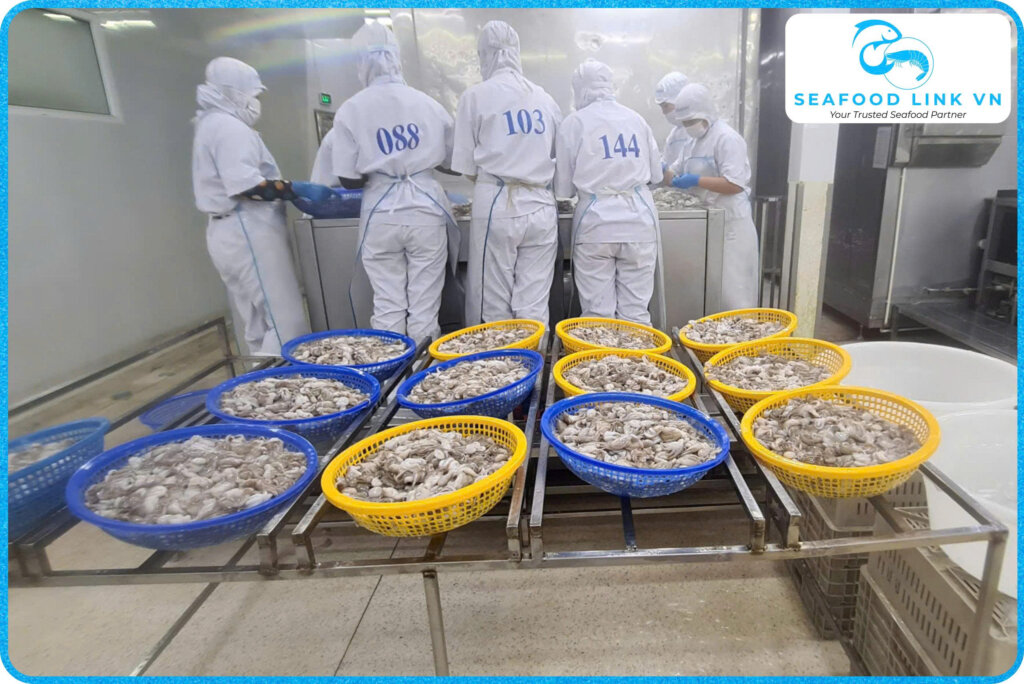
How Frozen Octopus Is Processed in Vietnam in an export-oriented seafood processing factory, covering washing, cleaning, grading, IQF freezing, metal detection and frozen storage.
HACCP and CCP Controls in Frozen Octopus Processing
Food safety is not controlled at only one point. It is managed throughout the entire production process.
A typical HACCP program considers three major categories of hazards:
Biological Hazards
Potential hazards may include pathogenic microorganisms and contamination resulting from poor temperature or hygiene control.
Chemical Hazards
Potential chemical hazards may include:
- Cleaning chemical residues
- Excessive additives where applicable
- Environmental contaminants
- Heavy metals where relevant
- Other hazards identified through the factory’s risk assessment
Physical Hazards
Potential physical hazards include:
- Metal
- Plastic
- Stones
- Hooks
- Other foreign materials
Representative Control Points
It is important to distinguish between a control point (CP) and a critical control point (CCP).
Not every important step in a processing flow is automatically a CCP. The actual CCPs must be determined through the factory’s HACCP hazard analysis, decision tree, validation, monitoring procedures, and corrective actions.
Based on a representative frozen baby octopus processing flow, important control parameters include:
| Processing Stage | Representative Control | Main Purpose |
|---|---|---|
| Raw material receiving | ≤4°C | Control temperature and raw material condition |
| Washing | Water ≤4°C | Hygiene and temperature control |
| Raw material storage | ≤4°C, limited holding time | Control microbial growth |
| Preliminary processing | Semi-finished product ≤7°C | Maintain product temperature |
| Semi-finished storage | ≤4°C, ≤4 hours | Limit temperature abuse |
| Final washing | Water ≤4°C | Final hygiene control |
| IQF freezing | ≤-40°C / validated time | Rapid freezing |
| Glazing | Water ≤4°C | Product protection |
| Metal detection | Fe 1.5 mm / SUS 2.0 mm in representative chart | Physical hazard control |
| Frozen storage | ≤-18°C | Maintain frozen condition |
| Container loading | Container ≤-18°C | Protect cold chain |
Important: The values above are representative parameters from the supplied processing chart and should not be presented as universal CCP limits for every Vietnamese octopus factory. Each approved factory should follow its own validated HACCP plan and customer/destination-market requirements.
Why Temperature Control Matters
Temperature is one of the most important quality parameters throughout frozen octopus production.
A simplified cold-chain sequence is:
Fishing → Chilling → Factory Receiving ≤4°C → Processing under controlled temperature → IQF Freezing → Frozen Storage ≤-18°C → Reefer Container ≤-18°C
Good temperature management helps preserve:
- Freshness
- Texture
- Natural flavor
- Appearance
- Shelf life
- Product safety
For buyers, temperature records and factory production records can also provide useful evidence during supplier evaluation and quality audits.
Quality Control Beyond the CCP
A professional seafood factory does not rely only on CCP monitoring.
Other quality-control activities may include:
Raw Material Inspection
Checking freshness, size, temperature, odor, appearance, and traceability.
Processing Inspection
Monitoring cleaning, washing, grading, cutting, freezing, glazing, and packing.
Finished Product Inspection
Depending on customer requirements, testing may include:
- Organoleptic quality
- Size
- Net weight
- Glazing
- Microbiological parameters
- Chemical parameters
- Physical hazards
- Label compliance
Pre-Shipment Inspection
For B2B export orders, buyers may request pre-shipment inspection covering:
- Product appearance
- Size
- Packing
- Carton condition
- Net weight
- Glazing
- Temperature
- Labeling
- Container condition
Seafood Link VN can coordinate inspection and production follow-up with processing partners according to the buyer’s requirements.
Traceability from Fishing Vessel to Export Container
For wild-caught seafood, traceability is becoming increasingly important in international trade.
A strong traceability system should connect key information across the supply chain:
Fishing Vessel → Landing Port → Raw Material Lot → Processing Factory → Production Lot → Finished Product → Container → Buyer
Important information may include:
- Vessel information
- Catch/landing information
- Landing date
- Fishing area where applicable
- Raw material lot
- Factory receiving record
- Production date
- Production lot
- Packing information
- Export documentation
Vietnam continues to strengthen fisheries monitoring, control, surveillance, and traceability as part of its efforts to combat IUU fishing. FAO also emphasizes end-to-end traceability and the identification of critical tracking events and key data elements throughout seafood value chains.
For seafood importers, this means supplier selection should consider not only price and product quality but also the ability to provide reliable origin and traceability documentation.
What Frozen Octopus Products Can Be Produced?
The processing flow can be adapted to different commercial products.
Seafood Link VN can support sourcing for:
Frozen Whole Cleaned Octopus
Whole octopus cleaned by removing unwanted internal parts while maintaining its natural shape.
Frozen Baby Octopus
Small-size octopus commonly supplied in IQF or block formats.
Frozen Cut Octopus
Cut according to customer requirements and suitable for foodservice or industrial processing.
Boiled Octopus
Cooked octopus products can be supplied in whole, cut, or tentacle formats depending on factory capability and customer specifications.
Value-Added Octopus
Products may include seasoned, breaded, grilled, or other ready-to-cook formats.
Why Source Frozen Octopus from Vietnam?
Vietnam offers international buyers several advantages when sourcing frozen octopus.
Diverse Raw Material Sources
Vietnam’s coastal fishing areas provide access to different octopus sizes and product types.
Experienced Seafood Processing Industry
Vietnam has developed extensive experience in processing and exporting frozen seafood products to demanding international markets.
Flexible Processing
Factories can produce:
- Whole
- Whole Cleaned
- Cut
- Tentacle
- IQF
- Block Frozen
- Boiled
- Seasoned
- Breaded
depending on factory capability and customer specifications.
Export-Oriented Quality Systems
Seafood processing establishments serving international markets operate under food safety and quality systems appropriate to their approved markets and customer requirements.
Flexible B2B Support
Seafood Link VN helps international buyers communicate product specifications, coordinate factory production, arrange QC inspections, and manage export documentation.
How Seafood Link VN Supports Frozen Octopus Buyers
Buying seafood internationally involves more than finding a factory and receiving a quotation.
We help buyers coordinate the complete sourcing process:
Product Inquiry → Factory Selection → Specification Confirmation → Quotation → Sample → Production → QC Inspection → Packing → Container Loading → Export Documentation
Our support can include:
- Factory sourcing
- Product specification
- Factory communication
- Production follow-up
- Quality inspection
- Pre-shipment inspection
- Packing verification
- Label checking
- Export documentation
- Container loading supervision
This is particularly useful for overseas buyers who want to source from Vietnam but do not have their own QC team on the ground.
Frequently Asked Questions
How is frozen octopus processed in Vietnam?
A typical process includes raw material receiving, washing, cleaning, grading, additional washing, IQF or block freezing, glazing where applicable, packing, metal detection, frozen storage, and container loading.
Where does Vietnamese octopus come from?
Vietnamese octopus is mainly sourced from marine fishing activities along the country’s coastal waters. Raw materials may come from different fishing areas depending on species, size, season, and factory sourcing network.
What temperature is used for receiving octopus?
A representative processing flow uses raw material temperature of ≤4°C at receiving. Actual requirements depend on the factory HACCP plan and product specification.
What temperature is used for IQF octopus?
The supplied representative factory flow chart specifies IQF freezing at approximately ≤-40°C for 15 minutes. Actual freezing parameters must be validated according to product size, equipment, loading, and factory HACCP procedures.
What is the storage temperature for frozen octopus?
A representative export process stores finished frozen products at ≤-18°C.
What is IQF octopus?
IQF means Individual Quick Frozen. Each piece is frozen individually, making the product easier to portion, handle, store, and use.
What is the difference between IQF and Block Frozen octopus?
IQF freezes individual pieces separately, while Block Frozen products are frozen together as a block. IQF is generally more convenient for retail and foodservice, while block freezing can be more economical for industrial processing.
Can octopus be supplied whole cleaned?
Yes. Whole Cleaned Octopus is one of the common export formats and can be supplied in different sizes according to customer requirements.
Can you supply baby octopus?
Yes. Frozen Baby Octopus is available in different size grades and can be supplied as whole cleaned, cut, IQF, or other formats depending on factory capability.
Can Seafood Link VN arrange quality inspection?
Yes. Seafood Link VN can coordinate production inspection, pre-shipment inspection, packing checks, and container loading supervision according to the buyer’s requirements.
Can you provide HACCP and factory documents?
Available documentation depends on the selected processing factory and destination market. Relevant food safety certificates, product specifications, processing information, and export documents can be reviewed during supplier qualification.
Explore More Seafood Products from Vietnam
For more information about Vietnam’s seafood supply chain and our product range, explore:
- Vietnam Cephalopod Supplier & Exporter | Premium Frozen Octopus, Squid & Cuttlefish
- Vietnam Frozen Octopus Supplier | Premium IQF Octopus Exporter
- Vietnam Frozen Cuttlefish Supplier | Whole, Cleaned & Cuttlefish Tube
- Vietnam Frozen Poulp Squid Supplier | Whole Round, Cleaned & Cut Poulp Squid
- Vietnam Frozen Loligo Squid Supplier | Whole Round, Tube & Ring
- Seafood Export from Vietnam – Complete Guide for Global Seafood Buyers
- Seafood Link VN Cephalopod Product Category
- Seafood Link VN Octopus Product Category
Industry Information
For additional information about Vietnam’s seafood industry, seafood export markets, processing capabilities, and fisheries traceability, buyers can refer to the Vietnam Association of Seafood Exporters and Producers (VASEP).
VASEP’s seafood portal provides information on Vietnam’s seafood sectors, suppliers, export potential, food safety, certifications, and fisheries-related regulations.
Contact Seafood Link VN
If you are looking for a reliable partner to source Frozen Octopus from Vietnam, Seafood Link VN is ready to support your project.
We can help you find suitable products and processing partners based on:
- Product type
- Size
- Processing style
- IQF or Block Frozen
- Glazing
- Packing
- Destination market
- Required certificates
- Order quantity
Contact Us
📧 Email: [email protected]
🌐 Website: seafoodlinkvn.com
📱 WhatsApp: +84 933 113 379
Send us your required specification and destination port. We will help you check suitable factory options and prepare a competitive quotation.
Conclusion
The production of frozen octopus in Vietnam is a carefully controlled process that begins long before the product reaches the processing factory.
From responsible fishing and rapid chilling to factory receiving, washing, cleaning, grading, IQF freezing, glazing, metal detection, frozen storage, and container loading, every stage contributes to the final quality of the product.
For international seafood buyers, the most important factors are not simply the final price per kilogram. A reliable supplier should also be able to demonstrate consistent raw material sourcing, cold-chain management, food safety controls, traceability, accurate specifications, and professional export support.
Seafood Link VN works with trusted seafood processing factories in Vietnam to connect international buyers with suitable frozen octopus products and reliable production partners.
Whether you need Frozen Whole Cleaned Octopus, Baby Octopus, Cut Octopus, IQF Octopus, Boiled Octopus, or value-added octopus products, we are ready to support your sourcing requirements from Vietnam.
