
When sourcing frozen seafood internationally, importers often face an important question:
Should I buy IQF or Block Frozen cephalopods?
Both freezing formats are widely used for octopus, squid, cuttlefish and other cephalopod products. Neither format is automatically better for every buyer.
The right choice depends on how the product will be sold and used, the required packing format, target market, processing needs, storage conditions, labor costs, and overall purchasing strategy.
For a seafood importer, understanding the difference between IQF and Block Frozen can help avoid unnecessary costs and ensure that the product format matches the actual business model.
This guide compares IQF vs Block Frozen Cephalopods from a practical B2B perspective, including processing, freezing, glazing, packing, storage, container loading, applications, cost considerations, and product selection.
What Are IQF and Block Frozen Cephalopods?
Before comparing the two formats, it is important to understand how they are produced.
What Is IQF?
IQF means Individual Quick Frozen.
With IQF processing, individual seafood pieces are frozen separately rather than being frozen together as one large block.
Depending on the product, an IQF line can process:
- Whole octopus
- Baby octopus
- Cut octopus
- Octopus tentacles
- Whole squid
- Squid tubes
- Squid rings
- Squid tentacles
- Cuttlefish
- Cuttlefish fillets
- Decorative cuts
The individual pieces remain separate after freezing, making it possible for buyers to take only the quantity required.
What Is Block Frozen?
Block Frozen products are arranged in a mold, bag, tray, or carton and frozen together as a compact block.
Depending on the product and specification, the block may contain:
- Whole squid
- Cuttlefish
- Octopus
- Cut octopus
- Squid tubes
- Other seafood portions
Block Frozen products are commonly supplied in bulk formats for wholesalers, food processors and customers who will further process or portion the product after import.
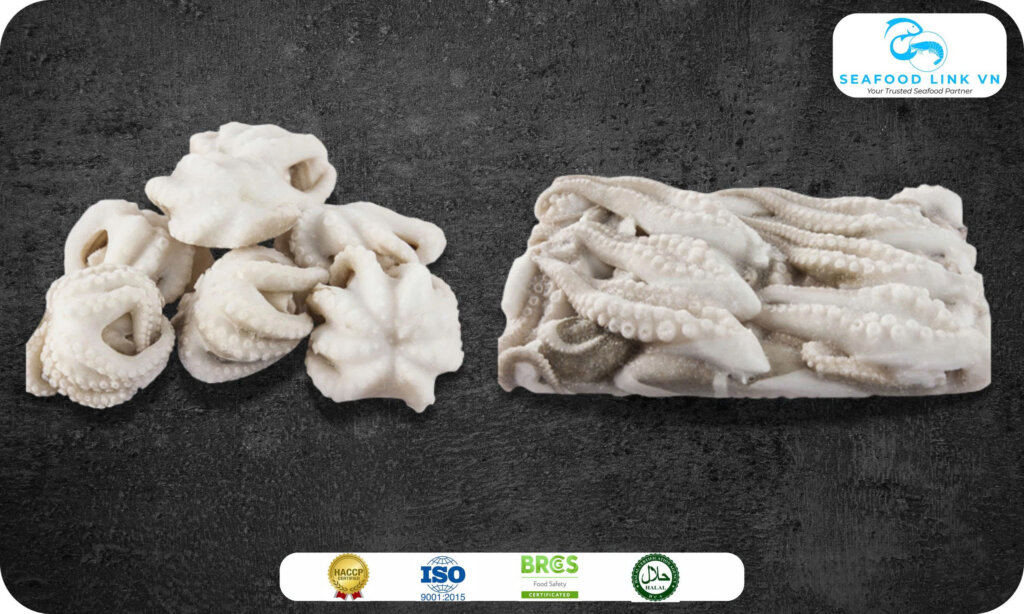
IQF vs Block Frozen Cephalopods: comparing individual frozen and block frozen octopus, squid and cuttlefish products for seafood importers.
IQF vs Block Frozen Cephalopods: Direct Comparison
| Criteria | IQF | Block Frozen |
|---|---|---|
| Product format | Individual pieces | Frozen block |
| Portion control | Excellent | Limited |
| Ease of handling | Very convenient | Less convenient |
| Retail suitability | Excellent | More limited |
| Foodservice | Excellent | Good |
| Industrial processing | Excellent | Excellent |
| Packaging cost | Usually higher | Usually lower |
| Processing cost | Usually higher | Usually lower |
| Product separation | Individual pieces | Pieces frozen together |
| Storage | Convenient | Efficient |
| Further processing | Very convenient | Often requires thawing |
| Bulk applications | Good | Excellent |
| Target buyers | Retail, foodservice, distributors | Processors, wholesalers, bulk buyers |
The important point is that IQF and Block Frozen are different commercial solutions, not simply different levels of product quality.
IQF Cephalopod Processing
The IQF production process varies depending on the species and factory, but a typical process may include:
1. Raw Material Receiving
Fresh octopus, squid or cuttlefish arrives at the processing factory.
QC personnel may check:
- Temperature
- Freshness
- Appearance
- Odor
- Size
- Raw material condition
- Traceability
The cold chain should be maintained from receiving through processing.
2. Washing and Cleaning
The raw material is washed using controlled-quality water.
Depending on the product, workers may remove:
- Internal organs
- Eyes
- Beak
- Quill
- Ink sac
- Foreign materials
For cut products, the product may then be processed into the required shape.
3. Size Classification
Products are sorted according to customer specifications.
Examples include:
- Pieces/kg
- Gram/piece
- Tube size
- Ring diameter
- Fillet size
- Tentacle size
Consistent grading is especially important for B2B customers.
4. Final Washing
After cleaning and cutting, products are washed again before freezing.
The objective is to ensure that the product enters the freezing line in a clean and controlled condition.
5. IQF Freezing
Individual pieces are rapidly frozen through an IQF freezing system.
The exact freezing temperature and residence time depend on:
- Product size
- Product thickness
- Equipment
- Production capacity
- Factory validation
- Customer specification
The objective is to achieve the required core temperature while preserving product quality and individual separation.
6. Glazing
Some IQF products are glazed after freezing.
Glazing provides a protective layer of ice that can help reduce dehydration and protect the product during frozen storage.
The glazing percentage must be agreed between buyer and supplier.
For example:
- 5% glazing
- 10% glazing
- Other customer specifications
For markets where net weight control is particularly important, buyers should clearly define whether the quoted weight is net of glazing.
7. Packing
After freezing and glazing, IQF products may be packed into:
- Polybags
- Vacuum bags
- Trays
- Retail bags
- Bulk bags
- Cartons
The individual pieces remain separate, allowing customers to use only the quantity required.
Block Frozen Cephalopod Processing
Block Frozen production follows a different approach.
1. Raw Material Preparation
The raw material is received, inspected, washed and cleaned according to the product specification.
2. Size Sorting
Products may be sorted before being placed into the freezing container or mold.
3. Block Formation
The product is arranged into a defined weight or size.
Typical formats may include:
- 500 g
- 1 kg
- 2 kg
- 5 kg
- Larger industrial blocks
The exact format depends on the customer’s requirements.
4. Freezing
The product is frozen together as one block.
The freezing method and parameters depend on the factory’s equipment and validated production process.
5. Packing
Frozen blocks are then packed into cartons or other suitable packaging.
This format can be highly efficient for bulk transportation and industrial processing.
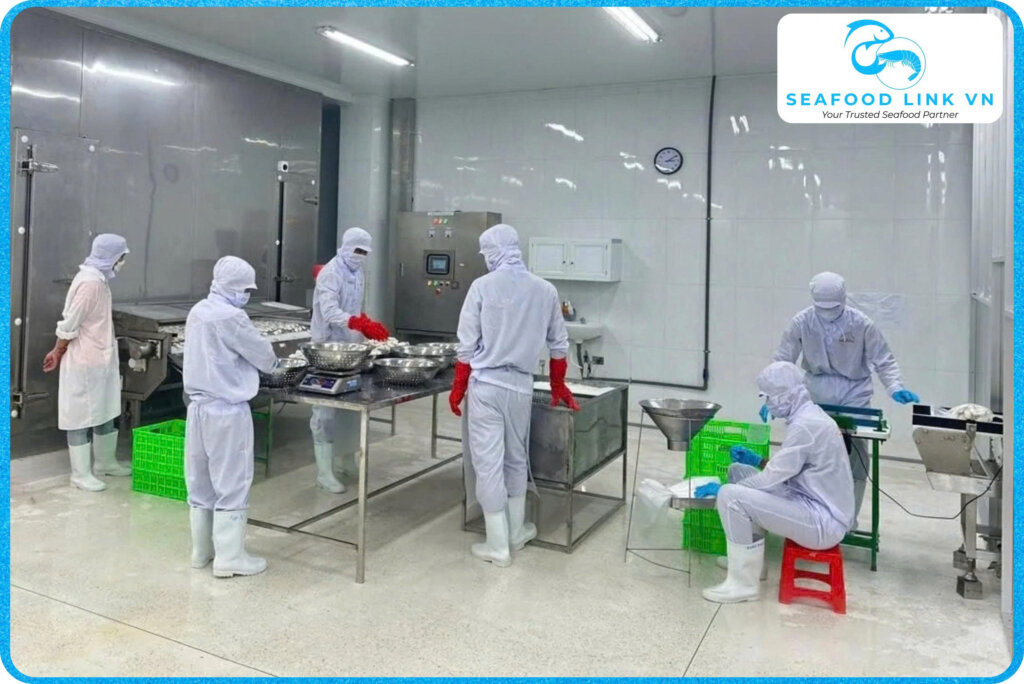
IQF vs Block Frozen Cephalopods during professional seafood processing, freezing, packing and quality control.
IQF vs Block Frozen: Which Has Better Quality?
This is one of the most common questions from importers.
The answer is:
Freezing format alone does not determine product quality.
A well-produced IQF product can have excellent quality, but a properly produced Block Frozen product can also maintain excellent quality.
Product quality depends on many factors:
- Raw material freshness
- Time between catch and processing
- Temperature control
- Hygienic processing
- Freezing conditions
- Glazing
- Packaging
- Frozen storage
- Transportation
- Temperature stability
For example, a high-quality fresh octopus that is properly processed and frozen in block form can be a better commercial product than poorly handled IQF octopus.
Therefore, buyers should evaluate the entire supply chain, not only whether the product is IQF or Block Frozen.
IQF vs Block Frozen: Cost Comparison
Cost is another major factor for importers.
Why IQF Can Cost More
IQF production generally requires:
- More sophisticated freezing equipment
- Individual product handling
- More processing control
- More packaging options
- Additional production management
Retail-ready IQF products may also require individual bags, trays, labels and other packaging materials.
Therefore, IQF can have a higher production and packing cost.
Why Block Frozen Can Be More Economical
Block Frozen production can reduce certain costs because multiple pieces are frozen together.
Potential advantages include:
- Lower packaging cost
- Efficient carton utilization
- Efficient bulk handling
- Lower processing complexity
- Good suitability for industrial buyers
For buyers purchasing large quantities for further processing, Block Frozen can therefore be an attractive option.
IQF vs Block Frozen: Packing
Packing is where the commercial difference becomes particularly clear.
Typical IQF Packing
Examples include:
1 kg × 10 bags/carton
or:
500 g × 20 bags/carton
Retail packing can also be customized:
- 300 g
- 500 g
- 1 kg
- Vacuum pack
- Tray pack
- Printed retail bag
Typical Block Frozen Packing
Examples include:
1 kg × 10 blocks/carton
2 kg × 5 blocks/carton
5 kg × 2 blocks/carton
The exact packing should be confirmed according to:
- Destination market
- Customer warehouse
- Retail requirements
- Container loading
- Target price
Container Loading and Logistics
The choice between IQF and Block Frozen can also affect logistics.
IQF
IQF products are usually packed into individual bags or smaller units before being packed into cartons.
This provides excellent handling flexibility but can require more packaging materials.
Block Frozen
Block Frozen products can make efficient use of carton space and are particularly suitable for bulk shipments.
For importers buying full-container quantities, the final loading efficiency should be calculated based on:
- Carton dimensions
- Net weight/carton
- Gross weight/carton
- Number of cartons
- Pallet requirements
- Destination regulations
Therefore, buyers should compare cost per usable kilogram, rather than simply comparing the factory price per kilogram.
Which Cephalopods Are Suitable for IQF?
IQF is particularly suitable when the buyer wants individual portion control.
IQF Octopus
Common products include:
- Baby Octopus
- Whole Cleaned Octopus
- Cut Octopus
- Octopus Tentacles
IQF Squid
Popular products include:
- Whole Round Squid
- Whole Cleaned Squid
- Squid Tube
- Squid Ring
- Tentacle
- Fillet
- Somen
IQF Cuttlefish
Products include:
- Whole Cleaned Cuttlefish
- Cuttlefish Tube
- Cuttlefish Fillet
- Pineapple Cut
- Flower Cut
- Strip Cut
- Dice Cut
Which Cephalopods Are Suitable for Block Frozen?
Block Frozen is especially useful for buyers purchasing bulk raw materials for further processing.
Typical products include:
- Whole Octopus
- Baby Octopus
- Cut Octopus
- Whole Squid
- Squid Tube
- Cuttlefish
- Cuttlefish Fillet
- Mixed seafood raw materials
The best format depends on what happens after the product arrives at the buyer’s warehouse.
IQF vs Block Frozen: Which Is Better for Different Buyers?
For Retailers
IQF is often more suitable because individual pieces are easy to portion, pack and sell.
Retail customers can use the amount they need without thawing an entire block.
For Restaurants
IQF can be convenient for restaurants because kitchen staff can take the required number of pieces.
This is particularly useful for:
- Squid rings
- Baby octopus
- Octopus tentacles
- Cuttlefish pieces
However, Block Frozen can also work well for high-volume kitchens where large quantities are prepared at once.
For Food Manufacturers
Both formats can work.
The decision depends on the production line.
If the factory needs individual pieces for automated processing, IQF can be more convenient.
If the product will be thawed and processed in bulk, Block Frozen may offer a cost advantage.
For Seafood Wholesalers
Both options are suitable.
The buyer should consider whether customers prefer:
- Individual portions
- Bulk blocks
- Retail packs
- Foodservice packs
For Industrial Buyers
Block Frozen can be attractive when the product will be further processed after import.
However, IQF can be more efficient when the production line requires individual pieces.
How Should Importers Choose?
Instead of asking:
“Is IQF better than Block Frozen?”
A better question is:
“Which format fits my business model better?”
Use this checklist:
Choose IQF when:
- You need individual pieces
- Portion control is important
- You sell to retail customers
- You supply restaurants
- You need convenient handling
- You require premium presentation
- You use automated processing
Consider Block Frozen when:
- You buy in bulk
- Your customers are industrial processors
- The product will be further processed
- Packaging cost is a major concern
- You need an economical bulk format
- Individual portioning is not required
How Seafood Link VN Can Support Your Sourcing
Seafood Link VN supplies different frozen cephalopod formats from Vietnam according to customer requirements.
Our product range includes:
Octopus
- Whole
- Whole Cleaned
- Baby Octopus
- Cut
- IQF
- Block Frozen
Cuttlefish
- Whole
- Cleaned
- Tube
- Fillet
- Pineapple Cut
- Flower Cut
- Strip
- IQF
- Block Frozen
Poulp Squid (Mada)
- Whole Round
- Whole Cleaned
- Cut
- Slice
- IQF
- Block Frozen
Loligo Squid
- Whole Round
- Whole Cleaned
- Tube
- Tentacle
- Ring
- Fillet
- IQF
- Block Frozen
We can help buyers compare product specifications, packing formats, factory options and target pricing before placing an order.
Frequently Asked Questions
Is IQF more expensive than Block Frozen?
IQF often has a higher processing and packaging cost because individual pieces are frozen and handled separately. However, the actual price depends on the species, size, processing, glazing, packing and order quantity.
Does IQF have better quality than Block Frozen?
Not necessarily. Both can have excellent quality when properly produced. Raw material freshness, processing hygiene, freezing conditions, cold-chain management and storage are critical factors.
Which is better for retail?
IQF is generally more convenient for retail because consumers can use individual pieces without thawing the entire package.
Which is better for industrial processing?
Either can work. Block Frozen can be economical for bulk processing, while IQF is useful when individual pieces are required during production.
Can Seafood Link VN supply both IQF and Block Frozen?
Yes. Seafood Link VN can source both formats for octopus, squid, cuttlefish and other cephalopod products, depending on factory capability and customer specifications.
Can the glazing percentage be customized?
Yes, glazing can be specified according to the product and market requirements. Buyers should clearly confirm whether the quoted weight is net weight excluding glazing.
Can you provide OEM and Private Label packing?
Yes. Customized bags, cartons, labels, barcodes, retail packaging and private-label solutions can be arranged depending on the product and factory.
Related Seafood Products and Guides
For more information about frozen cephalopods from Vietnam:
- Cephalopod Products — explore our full range of frozen octopus, squid and cuttlefish.
Cephalopod Products - Octopus Products — whole, cleaned, baby octopus, cut and IQF options.
Octopus Products - Vietnam Frozen Octopus Supplier | Premium IQF Octopus Exporter
Vietnam Frozen Octopus Supplier - Vietnam Frozen Cuttlefish Supplier | Whole, Cleaned & Cuttlefish Tube
Vietnam Frozen Cuttlefish Supplier - Vietnam Frozen Poulp Squid Supplier | Whole Round, Cleaned & Cut Poulp Squid
Vietnam Frozen Poulp Squid Supplier - Vietnam Frozen Loligo Squid Supplier | Whole Round, Tube & Ring
Vietnam Frozen Loligo Squid Supplier - Vietnam Cephalopod Supplier & Exporter | Premium Frozen Octopus, Squid & Cuttlefish
Vietnam Cephalopod Supplier & Exporter - Seafood Export from Vietnam – Complete Guide for Global Seafood Buyers
Seafood Export from Vietnam – Complete Guide - How Frozen Octopus Is Processed in Vietnam
How Frozen Octopus Is Processed in Vietnam
Vietnam Seafood Industry
Vietnam has a well-established seafood processing and export industry serving international markets with frozen fish, shrimp, squid, cuttlefish, octopus and other seafood products.
For industry information, export updates and seafood market information, buyers can also visit the Vietnam Association of Seafood Exporters and Producers.
Vietnam Association of Seafood Exporters and Producers (VASEP)
Contact Seafood Link VN
Still unsure whether IQF or Block Frozen is better for your product?
Send us your:
- Product
- Size
- IQF or Block preference
- Packing requirement
- Quantity
- Destination port
We can help check suitable production options and prepare a quotation based on your actual requirements.
Contact Us – Seafood Link VN
📧 Email: [email protected]
🌐 Website: Seafood Link VN
📱 WhatsApp: +84 933 113 379
Let’s find the right frozen cephalopod format for your market.
Conclusion
There is no universal winner between IQF and Block Frozen cephalopods.
IQF provides excellent convenience, portion control, individual handling and retail or foodservice flexibility. It is particularly suitable for products such as squid rings, squid tubes, baby octopus, cut octopus and decorative cuttlefish.
Block Frozen can provide a more economical bulk solution for wholesalers and industrial processors, particularly when the product will be thawed and further processed after import.
For seafood importers, the best decision should consider the entire commercial chain:
Raw Material → Processing → Freezing → Glazing → Packing → Container Loading → Storage → Final Application
At Seafood Link VN, we can support both IQF and Block Frozen sourcing for octopus, squid and cuttlefish from Vietnam, with customized specifications and packing solutions for different international markets.
The right question is not simply “IQF or Block?” — it is “Which format gives my business the best balance of quality, convenience and total cost?”
